
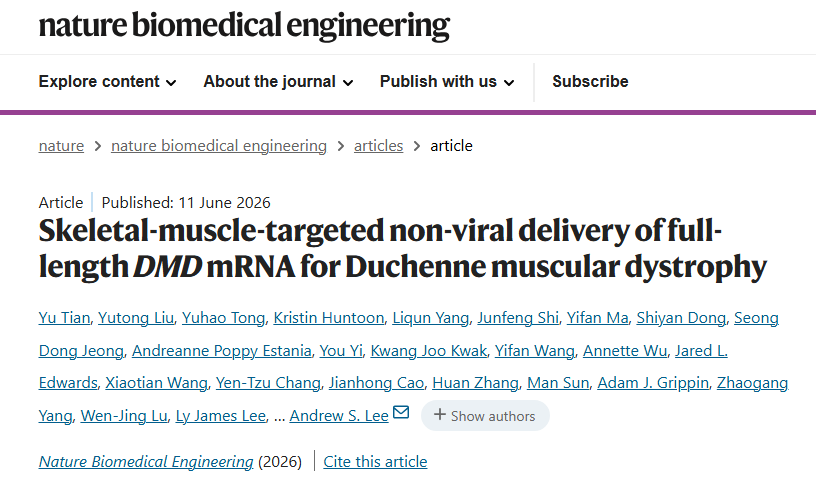
近日,由北京大学深圳研究生院、深圳湾实验室、美国 MD Anderson 癌症中心、中国医学科学院阜外医院深圳医院、 深圳医学科学院粤港澳大湾区国际临床试验中心以及上海思珀诺因生物科技有限公司等机构组成的跨国科研团队在国际权威期刊Nature Biomedical Engineering 上发表了具有里程碑意义的研究成果。
该研究首次系统性验证了基于工程化细胞外囊泡(EVs)的非病毒(non-viral)基因治疗策略,通过静脉给药将全长抗肌萎缩基因(full-length dystrophin gene)精准递送至骨骼肌组织,并在DMD基因敲除小鼠以及非人灵长类动物(NHPs)中实现长期、安全的蛋白表达与显著的功能改善。
Recently, a multinational research team composed of Peking University Shenzhen Graduate School, Shenzhen Bay Laboratory, MD Anderson Cancer Center, Fuwai Shenzhen Hospital, Chinese Academy of Medical Sciences, SMART Greater Bay Area International Clinical Trials Center, and Spot Biosystems Co., Ltd. (Shanghai) published a landmark study in the internationally renowned journal Nature Biomedical Engineering.
This is the first study to systematically verify a non-viral extracellular vesicles (EVs)–based gene therapy strategy that enables precise delivery of full-length dystrophin gene to skeletal muscle with intravenous injection, achieving long-term, safe protein expression and significant functional improvement in DMD-KO mice, as well as in non-human primates (NHPs).
非病毒基因疗法重大突破
深圳湾实验室等实现工程化囊泡递送全长抗肌萎缩基因,DMD蛋白水平提升超10倍
A Major Breakthrough in Non-Viral Gene Therapy
—Shenzhen Bay Laboratory and Partners Deliver Full-Length Dystrophin via Engineered EVs, Achieving >1000% Increase in DMD Patients
DMD治疗的核心挑战
Core Challenges in DMD Treatment
杜氏肌营养不良症(DMD)是一种由X染色体上抗肌萎缩基因突变引起的严重遗传性神经肌肉疾病,全球发病率约为每3,500名男性新生儿中1例。现有疗法在延缓或阻止进行性肌肉退化方面仍存在明显局限性,患者的病情往往最终进展至呼吸衰竭并早逝。近年来,多项 AAV 基因治疗DMD的临床试验中相继出现严重的病毒免疫反应和器官毒性事件,包括辉瑞(Pfizer)、Sarepta、Astellas等公司的临床研究均报告了严重不良事件,部分试验中出现患者死亡案例,引发了学术界和监管机构对 AAV 基因疗法安全性的广泛关注,也凸显了开发更安全、可支持重复给药的非病毒基因治疗技术的迫切需求。
Duchenne muscular dystrophy (DMD) is a severe inherited neuromuscular disorder caused by mutations in the dystrophin gene on the X chromosome, with a global incidence of approximately 1 in 3,500 male newborns. Current therapeutic options have obvious limitation in delaying or halting progressive muscle degeneration, and patients’ condition ultimately progresses to respiratory failure and premature death. In recent years, severe viral immune responses and organ toxicity was found in multiple AAV gene therapy clinical trials for DMD treatment, and serious adverse events were reported in clinical trials by many companies, including Pfizer, Sarepta, and Astellas, and some trials reported patient death. This has raised widespread concerns in academia and regulatory agencies regarding the safety of AAV gene therapy, and highlighted the urgent need for the development of safer non-viral gene therapy technologies that can support repeat administration.
研究创新:基于细胞外囊泡的非病毒基因治疗平台
Research Innovation: A Non-Viral Gene Therapy Platform Based on Extracellular Vesicles
在本项研究中,研究团队开发了一种新型的非病毒基因治疗平台,利用工程化细胞外囊泡(EVs)作为递送载体封装全长抗肌萎缩基因,并实现对骨骼肌组织的靶向递送。该平台可通过静脉注射实现全身给药,从而克服局部给药在临床应用中的局限性。
In this study, the research team developed a novel non-viral gene therapy platform that utilizes engineered extracellular vesicles (EVs) as delivery vehicles to encapsulate full-length dystrophin gene, and achieves target delivery to skeletal muscle tissue. This platform enables systemic administration via intravenous injection, which overcomes the limitations of local administration in clinical applications.
与 AAV 基因疗法相比,该 EV 基因治疗平台的关键优势:
完全非病毒,从机制层面降低病毒载体相关免疫原性和毒性风险;
可递送全长抗肌萎缩基因,突破因AAV载体容量限制而无法递送全长治疗基因的技术瓶颈;
支持重复给药,突破AAV疗法因载体免疫原性导致的单次给药限制;
更适用于DMD 这类需要长期、持续蛋白补充的慢性遗传性疾病及其他罕见病。
Compared to AAV gene therapy, this EV-based gene therapy platform provides several key advantages:
Completely non-viral, reducing the risk of viral-related immunogenicity and toxicity at the mechanism level;
Capable of delivering full-length dystrophin gene, overcoming the technical bottleneck of AAV vector capacity limitations which is unable to deliver full-length therapeutic genes;
Supports repeat administration, overcoming the limitation in single administration of AAV therapies by vector immunogenicity;
More applicable to chronic genetic diseases like DMD and other rare disease, which requires long-term and sustained protein supplementation.
动物实验数据扎实:持续表达与显著功能改善
Robust Animal Data: Sustained Expression and Significant Functional Improvement
在Nature Biomedical Engineering 发表的论文中,研究团队展示了具有说服力的临床前数据:在DMD基因敲除模型小鼠体内,经EV递送的全长抗肌萎缩基因在骨骼肌中实现持续且稳定的蛋白表达,并显著改善小鼠的肌肉力量、耐力及整体运动功能。同时,在非人灵长类动物实验中,多次静脉给药后可观察到骨骼肌内持续的蛋白表达,且未检测到肝、肾或心脏毒性反应,进一步验证了该平台的转化潜力。
In the Nature Biomedical Engineering paper, the research team presented compelling preclinical data: Full-length dystrophin gene delivered via EVs achieved sustained and stable protein expression in skeletal muscle of DMD knockout model mice, and significantly improved muscle strength, endurance, and overall motor function. Furthermore, repeated intravenous administrations resulted in sustained protein expression in non-human primates skeletal muscle, without liver, kidneys, and cardiac toxicity, which further validating the translational potential of this platform.
临床转化:首个人体试验已获初步安全验证
Clinical Study: First Human Trial Shows Preliminary Safety Validation
基于上述扎实的临床前数据,研究团队迅速将成果推向临床转化。一项由研究者发起的临床试验(IIT)已在上海儿童医学中心(Shanghai Children’s Medical Center, SCMC)展开(ClinicalTrials.gov 登记号:NCT07188012),旨在评估该 EV基因疗法在儿童 DMD 患者中的安全性及初步有效性。两名首批入组患者的初步数据显示,该疗法能够安全地将全长抗肌萎缩基因递送至DMD患者的骨骼肌组织,使抗肌萎缩蛋白水平提升超过1000%。并且,北极星步行评估(NSAA)的结果也表明入组患者的肌肉功能得到了改善。需要指出的是,目前仅有两名患者的结果,尚不足以确认该疗法在更广泛人群中的有效性和安全性,这些发现需在更广泛的患者群体中和更长的治疗周期中进一步验证,以评估其作为可持续药物疗法的可行性。
Based on the robust preclinical evidence, the research team has rapidly advanced these findings toward clinical translation. An investigator-initiated trial (IIT) has been launched at Shanghai Children's Medical Center (SCMC) (ClinicalTrials.gov ID: NCT07188012), aiming to evaluate the safety and preliminary efficacy of this EV gene therapy in children DMD patients. The data of the first two enrolled participants show that this therapy can safely deliver full-length dystrophin gene to the skeletal muscle tissue of DMD patients, with over 1000% increase in dystrophin protein expression restoration and improvement in muscle function as measured by the North Star Ambulatory Assessment (NSAA). It should be noted that the results from only two patients are too early to confirm efficacy and safety in a broader population and these findings need to be further verified with a larger patient population and extended treatment duration to determine the feasibility of a sustainable pharmaceutical therapy.
这是全球首次成功将全长抗肌萎缩基因递送至DMD患者的骨骼肌并伴随肌肉功能改善的报道,相关研究成果将于未来进一步披露。
This is the first report of successful delivery of full-length dystrophin gene to skeletal muscle in human DMD patients all over the world, and it shows improvements in muscle function. Relevant research findings will be further disclosed in the future.
里程碑意义与未来展望
Milestone Significance and Future Outlook
这项发表于Nature Biomedical Engineering 的研究首次系统性证明,基于细胞外囊泡(EVs)的非病毒基因治疗平台可实现全长抗肌萎缩基因的安全、可重复递送,并在 DMD 模型小鼠及非人灵长类动物中实现持续表达与功能改善。结合已启动并显示初步积极信号的人体临床试验结果,该研究为DMD治疗提供了一种新的技术路径。该非病毒 EV 基因疗法目前仍处于早研阶段,其是否能够最终转化为成熟且具有广泛临床应用潜力的治疗产品,仍有待进一步验证。鉴于这是一个全新的非病毒基因治疗平台,并且是团队首次开展人体临床研究,在确定其广泛临床可行性之前,仍需在基础研究与临床研究层面回答诸多关键科学问题。
论文通讯作者表示:“本研究不仅为DMD治疗提供了一种更安全、更有效的潜在治疗策略,更重要的是,验证了非病毒EV平台在递送大基因药物方面的巨大潜力,为现有病毒载体技术难以覆盖的多种遗传性疾病提供了潜在的替代治疗途径。要推动这些初步发现向更广泛患者群体转化,仍需开展更多研究工作。我们未来的研究将重点评估在小鼠、非人灵长类动物及首批DMD患者中观察到的抗肌萎缩蛋白表达恢复和肌肉功能改善,能否在更广泛的患者群体中重复实现,并系统评估生产工艺、给药周期延长以及不同药物剂量和剂型等因素带来的影响。我们将持续发表临床前和临床试验的研究发现,以推动DMD疾病治疗和非病毒基因治疗领域的进展。”
Taken together, this study published in Nature Biomedical Engineering first systematically demonstrates that a non-viral EV-based gene therapy platform can achieve safe, repeat delivery of full-length dystrophin gene, resulting in sustained expression and function improvement in DMD-KO mice and non-human primates. Combined with the preliminary positive signals from the human clinical trial, this study offers a novel technology for DMD treatment. It should be specified that the non-viral EV gene therapy still locates in an early development, and the transformation into a mature, widely applicable therapeutic agent remains to be further validated. As this is a novel non-viral gene therapy platform and the team's first clinical study, numerous key scientific questions still need to be addressed in both the fundamental and clinical research, before confirming its broad clinical feasibility.
As stated by the corresponding author of the study, “This work not only provides a proof of concept for a potentially safer and more effective therapeutic strategy for DMD treatment, but more importantly, validates the immense potential of non-viral EV platforms for the delivery of large genetic medicines, offering a potential alternative avenue of treatment for numerous genetic disease problems that cannot be solved with existing viral vector technologies. More work is needed to validate these initial findings for translation to a larger patient population. Our future research will focus on assessing whether the dystrophin protein restoration and muscle function improvement observed in mice, non-human primates, and the first DMD patients can be replicated in a larger patient population. It will need to evaluate the influence of manufacturing process, extended administration duration, and different dosages and formulations, particularly. We are committed to the continuously report research findings from preclinical and clinical trials to advance the overall study progress in DMD treatment and non-viral gene therapy.”
原文信息:
Skeletal-muscle-targeted non-viral delivery of full-length DMD mRNA for Duchenne muscular dystrophy
供稿 | Andrew Lee课题组
编辑 | 白 白
责编 | 远 山
欢迎投稿、建议 | media@szbl.ac.cn


 粤公网安备44031102000926号